
Dead Frequency
A Hard Science Fiction Short Story

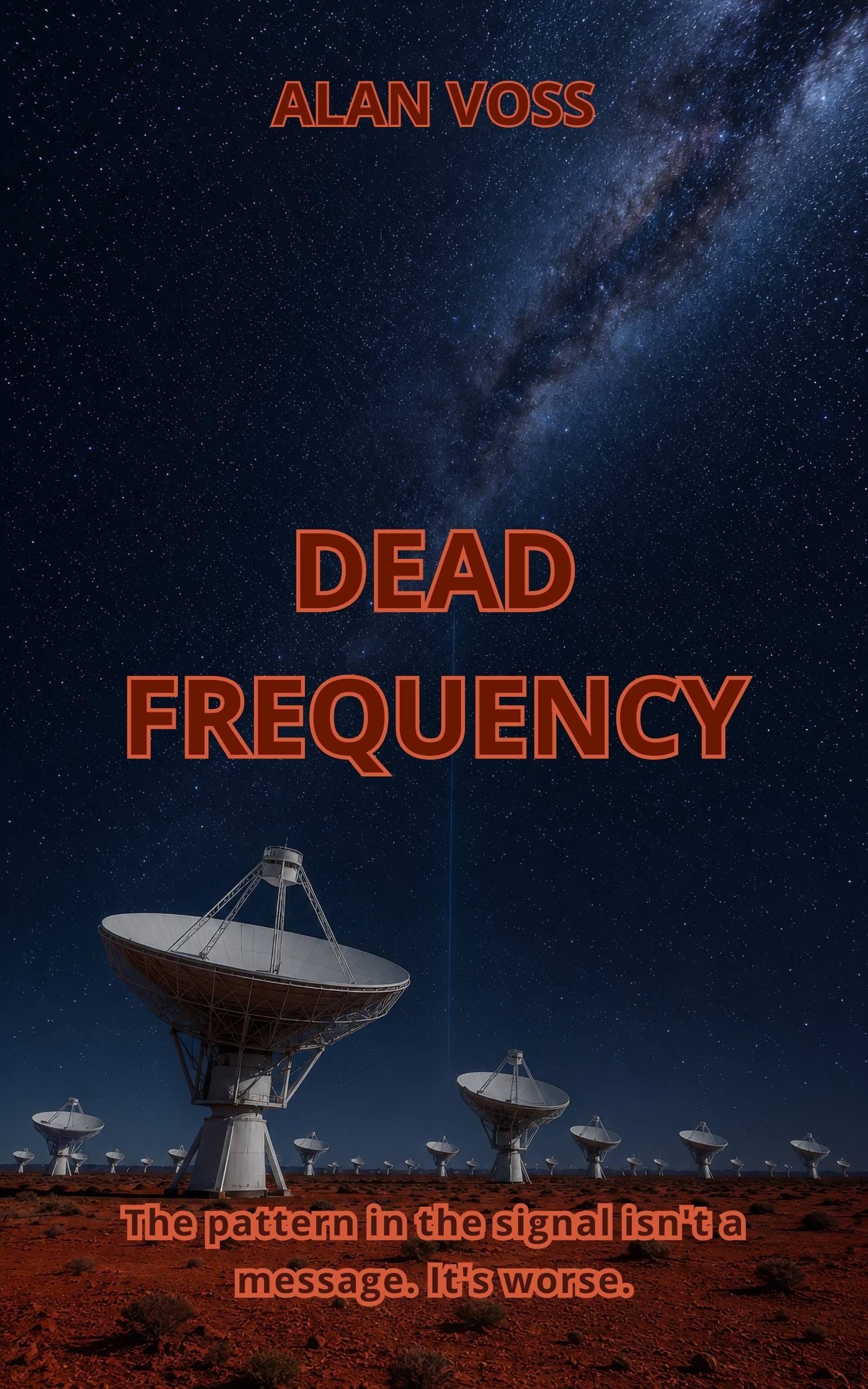
The Gaps
The cat was staring at her again.
Lena looked up from her laptop and found Kepler sitting on the counter beside the cold kettle, his amber eyes fixed on her with that particular intensity cats reserved for things they either wanted to eat or couldn’t understand. In Kepler’s case, these categories overlapped more than she liked to admit.
“I fed you,” she said.
Kepler blinked. Slowly. The way cats did when they were calling you a liar without the decency of using words.
“An hour ago. The expensive stuff. With the little gravy packets.”
Nothing.
“I’m not getting up.”
She got up. She crossed the narrow kitchen of her facility issued bungalow (three rooms, a bathroom with a shower that ran brown for the first thirty seconds, and a view of approximately one million acres of red dirt in every direction) and opened the cabinet where she kept the cat food. Kepler had already begun purring.
“You’re a manipulative little bastard,” she told him, scooping kibble into his bowl. “You know that, right? You know you’re doing it.”
Kepler ate. He did not dignify this with a response.
Lena leaned against the counter and looked out the window. It was 9:47 PM, which in Murchison Shire, Western Australia, meant that the sky had gone from its daytime blue to the kind of black that people in cities never saw. Not dark. Black. The Milky Way cut across it like a wound, so thick with stars it almost looked solid, and the southern constellations hung there (Crux, Centaurus, Carina) with a clarity that still made her chest ache after three years of living out here.
Three years. Christ.
She’d come to the Murchison Widefield Array on a two year postdoc from the Max Planck Institute for Radio Astronomy in Bonn, chasing a dataset of repeating fast radio bursts that nobody else wanted because the repeaters were messy and the one offs got all the Nature papers. Tom Beckley had offered her an extension because (and she was quoting here) “You’re the only person I’ve ever met who actually wants to be in the middle of nowhere.” He’d said it like it was a compliment and a diagnosis at the same time.
She went back to her laptop.
The data on the screen was from FRB 20251107A, a repeating fast radio burst that the array had been tracking for eleven weeks. Most FRBs were one and done. A single millisecond flash of radio energy from deep space, releasing more energy in that eyeblink than the Sun pumped out in an entire day, and then silence forever. But some of them came back. FRB 20220912A had repeated over 1,600 times. The current consensus was magnetars, neutron stars with magnetic fields strong enough to rearrange your atoms from a thousand light-years away, but the consensus was also that the consensus might be wrong.
Lena liked the ones that didn’t fit.
FRB 20251107A was one of those. Its dispersion measure (the way the radio pulse smeared across frequencies as it traveled through intergalactic plasma) put it at about 1.4 gigaparsecs. Roughly four and a half billion light-years. That wasn’t especially far for an FRB, but it was far for a repeater with this cadence. No magnetar model she’d seen could make the repetition rate work without invoking physics that would get you laughed out of a conference.
She’d flagged it six weeks ago. Tom had nodded and said, “Interesting,” in the way he said “interesting” when he meant “please don’t make this my problem.”
So she’d been working it alone. Nights, mostly. The array ran autonomously during observations, thirty six parabolic dishes spread across the red dirt like enormous flowers turned toward the sky, and the control building was empty after ten. She liked it. The hum of the servers, the tick of cooling fans, the data scrolling in neat columns of numbers that most people would find soul crushingly boring but which to Lena were (she’d never said this out loud) beautiful.
She had 847 recorded bursts. She’d cleaned the data, stripped interference, corrected for dispersion, and stacked the pulses by arrival time. Standard stuff.
And then she’d done something that wasn’t standard.
She’d looked at the gaps.
The thing about pattern recognition is that you can’t turn it off. Lena had known this about herself since she was eight years old and had noticed that the tiles in her grandmother’s kitchen in Freiburg weren’t actually random. There was a repeating motif every forty seven tiles that the manufacturer had probably thought was subtle enough to pass as irregular. She’d spent three hours counting to prove it. Her Oma had found her sitting on the floor with a notebook and said, in the flat Alemannic German of the Black Forest, “This one is going to be either very successful or very difficult to live with.”
Both, as it turned out.
Lena saw patterns the way some people saw color. Automatically, involuntarily, the structure just there in the noise like a shape in a Magic Eye poster, snapping into focus whether you wanted it to or not. It had made her a very good radio astronomer. It had also made her a person who ate dinner alone most nights talking to a cat named after a dead German who’d have appreciated the irony.
The gaps between the bursts from 20251107A were not random.
She’d noticed it first as a feeling, a wrongness, like a note slightly off key, and then she’d gone looking for it with math. She’d taken the inter burst intervals, all 846 of them, and run them through every statistical test she knew. Kolmogorov-Smirnov. Anderson-Darling. Autocorrelation out to lag 200. She’d looked for periodicity, quasiperiodicity, power law clustering, Poisson deviation.
What she’d found was this. The intervals weren’t periodic. They weren’t quasiperiodic. They weren’t clustered in any pattern consistent with a magnetar’s magnetic field reconnecting and firing. They were structured. There was a sequence, not a simple one, not a heartbeat, but a nested series of intervals that repeated with a cycle length of 127 bursts. Within each cycle, sub-patterns of shorter and longer gaps appeared in the same positions every time, like phrases in a sentence she couldn’t read yet.
She’d stopped herself at that point. Closed the laptop. Gone outside and stood in the dark for twenty minutes breathing the dry mineral smell of the outback, telling herself she was doing the thing she always did. Finding patterns in noise because that’s what her brain wanted to do, the way a hammer wanted everything to be a nail.
She’d gone back inside and checked her work.
It held up.
Not Noise
“You look like shit,” Marcus said.
It was 7:30 in the morning and Lena was in the control building’s small kitchen, standing in front of the coffee machine with the focused intensity of someone defusing a bomb. The coffee machine was Italian, expensive, and temperamental. Marcus had named it Lucia because, he said, “She’s beautiful but she’ll burn you if you’re not paying attention.”
“Thank you, Marcus. That’s very helpful.”
“I’m serious. When did you sleep?”
“I slept.”
“When?”
“Recently.”
Marcus Cole was twenty nine, built like a rugby player who’d discovered craft beer, and had the peculiar combination of being genuinely excellent at his job (he kept the array’s thirty six dishes calibrated to within fractions of an arcsecond) while also maintaining an encyclopedic knowledge of conspiracy theories that he discussed with the cheerful enthusiasm of a man who didn’t actually believe any of them but found them aesthetically pleasing. He had a podcast. It had eleven listeners. Lena was one of them, which she would deny under oath.
“I found something,” she said.
“In the FRB data?”
“In the gaps between the bursts.”
Marcus raised an eyebrow. He was holding a toast with Vegemite on it, the thick smear of a true believer. “Gaps like... pauses? Silences?”
“Intervals. The time between each burst. They’re not random.”
“Nothing’s truly random. You taught me that. Everything’s Poisson or power law or...”
“They’re not those either. They’re structured. There’s a repeating pattern with a cycle of 127 bursts, and within each cycle, the intervals map to...” She stopped. Took a breath. “Can I show you something?”
They went to her workstation. Lena pulled up the visualization she’d built the night before, a plot of inter burst intervals for ten complete cycles, stacked vertically, each cycle color coded. The patterns lined up like vertebrae.
Marcus stared at it. He chewed his toast slowly.
“Huh,” he said.
“Yeah.”
“That’s... I mean, that’s not noise.”
“No.”
“Have you told Tom?”
“I’m going to. I wanted someone else to look at it first. Someone who’d tell me if I was...”
“Seeing things?”
She nodded.
Marcus looked at the screen. He chewed his toast. Looked at the screen again. When he turned to her his face had an expression she hadn’t seen on it before. Something careful, something that had set aside the usual easygoing humor.
“You’re not seeing things,” he said. “But Lena, what are you seeing?”
Tom Beckley’s office was the only room in the control building with a window that faced something other than desert. It faced the array instead, which was more or less the same thing but with dishes. He was fifty three, gray at the temples in a way that looked distinguished in the department headshots, and he ran the Murchison facility with the quiet competence of a man who had learned long ago that the key to a successful career in radio astronomy was to not be the person who claimed to have found aliens.
“It’s interesting,” he said.
There it was.
“Tom...”
“I said it’s interesting. I mean it. The pattern you’ve found is statistically significant, I can see that. But Lena, you know what we’re dealing with here. FRBs are... we’re still in the taxonomy phase. We don’t even have consensus on the emission mechanism. Magnetar models can produce structured emission patterns. Crustal oscillations, magnetic field topology, plasma lensing...”
“I’ve considered all of those. The structure I’m seeing isn’t consistent with any of them.”
“Isn’t consistent yet. We don’t fully understand magnetar physics. There could be...”
“A 127 burst cycle with nested sub-groups that repeat in the same positions every time? With the same internal timing ratios to four decimal places? From crustal oscillations?”
Tom leaned back in his chair. He had a way of going very still when he was uncomfortable, like a lizard on a rock. “What exactly are you suggesting the alternative is?”
Lena had been dreading this question. Not because she didn’t have an answer, but because she did, and it was the kind of answer that ended careers in a specific and ugly way.
“I’m not suggesting anything yet. I’m saying the data shows structure that natural emission models can’t explain, and I want to keep working on it. I want to request dedicated observation time. Two more weeks on 20251107A, full bandwidth, continuous coverage.”
“Two weeks of dedicated array time. For one source.”
“Yes.”
Tom picked up a pen and set it down again. “You know how many proposals are in the queue?”
“I know.”
“And you know what happens if you go public with...” He gestured vaguely at the air, as if her findings were a bad smell. “With implications, before we have a natural explanation nailed down?”
“I’m not going public. I’m asking for array time.”
“You’re asking for array time to investigate what you think might be...”
“I’m asking for array time to investigate an anomalous emission pattern in a repeating FRB. That’s it. That’s the proposal.”
Tom looked at her for a long moment. Then he sighed, the sigh of a man who had managed radio astronomers for twenty years and recognized an immovable object when he was arguing with one.
“One week,” he said. “After the current survey block ends. And Lena, keep this between us for now. Please.”
“Understood.”
She was at the door when he added, quietly, “And get some sleep. Marcus is right. You look terrible.”
She called Helen that night.
Dr. Helen Park was sixty one, a professor of astrophysics at MIT, and the person who had supervised Lena’s PhD with a combination of intellectual rigor and maternal warmth that Lena’s actual mother, a cardiologist in Hamburg who considered astronomy a hobby, had never quite managed. Helen answered phone calls with “What’s wrong?” which was alarming and comforting in equal measure.
“What’s wrong?”
“Nothing’s wrong. I found something. I’m working a repeating FRB. 20251107A. DM puts it at about four and a half billion light-years. Eleven weeks of data, 847 bursts. The inter burst intervals are structured.”
Silence on the line. Not the silence of someone who wasn’t listening, but the silence of someone listening very carefully.
“Structured how?”
Lena explained. The 127 burst cycle. The nested sub-groups. The timing ratios that held across every repetition. She talked for twelve minutes without stopping, and Helen let her, which was itself unusual. Helen Park was not a woman who suffered monologues gladly.
When Lena finished, Helen said, “Send me the data. All of it. Raw, cleaned, and your analysis pipeline. I want to reproduce this independently.”
“You believe me?”
“I believe you found something. Have you considered that the structure could be an artifact? Terrestrial interference?”
“The signal’s at the right DM. It’s extragalactic. You can’t fake that dispersion with local interference.”
“No. You can’t.” A pause. “He’s not wrong about keeping quiet, you know. You understand the history of people who’ve gone public with things that look like this?”
“And if it’s not a magnetar quirk? If no natural model produces this kind of regularity?”
Helen didn’t answer right away. Lena could hear her breathing, the faint creak of a chair. Then, “Then we need to figure out what kind of process does. Send me everything tonight.”
“Thank you, Helen.”
“Don’t thank me yet. And Lena, sleep.”
“Everyone keeps saying that.”
“Because you keep not doing it.”
Engine Noise
She didn’t sleep. She went to the control building.
The facility at night was a cathedral of quiet. The server room hummed its subsonic hymn behind closed doors. The corridor lights were dimmed to amber, casting long shadows that moved when you weren’t looking directly at them, which was a trick of peripheral vision and fluorescent flicker and not, Lena reminded herself, anything else. The control room itself was a long space with two rows of workstations, most dark, and a wall of monitors showing the array’s status. Dish positions, system temperatures, data throughput, the usual liturgy of numbers that said everything is fine, everything is working, the universe is talking and we are listening.
She sat down at her station and opened the latest data from 20251107A.
The extra observation time Tom had granted wouldn’t start for three days, but the source was still being captured in the background of the current survey, low priority, a few hours of incidental coverage per night. She pulled the most recent bursts, fourteen new ones since yesterday, and fed them into her pipeline.
They fit. Cycle position 603 through 616. Right where they should be in the fifth repetition of the 127 burst pattern.
She leaned back and stared at the ceiling.
The thing she hadn’t told Helen, she hadn’t told anyone, was what she’d tried to do with the structure. And what had happened when she’d failed.
She’d spent four days trying to decode the intervals as a message. The obvious first move. Normalize to the shortest gap in each cycle, look for constants, ratios, mathematical relationships. Pi. Prime sequences. Fibonacci. Hydrogen spin-flip as a universal unit. She tried them all. The intervals, when normalized, produced numbers that were suggestive but never quite locked into any mathematical language she recognized. She could force patterns if she squinted hard enough, but forcing was the thing she’d promised herself she would never do. The data either spoke or it didn’t.
It didn’t. Not as a message.
But on the fourth night, frustrated, she’d done something different. She’d stopped asking what does it say and started asking what does it do. She’d plotted the intervals not as a sequence to decode but as a waveform. A timing profile. Thrust on, thrust off. Pulse, coast, pulse, coast. The nested sub-groups looked different when you thought of them that way. They looked like a duty cycle. A machine running through its operational phases. The 127-burst period wasn’t a message length. It was a cycle time. The intervals between bursts mapped to the on-off cadence of something being fired, repeatedly, in a pattern designed for sustained acceleration.
She’d pulled up three papers from her grad school days. Theoretical work on beamed-energy propulsion, the kind that got published in Acta Astronautica and quietly ignored by everyone with grant money. Forward’s laser sail. The Breakthrough Starshot concept. Marx’s 1966 paper on interstellar probes pushed by microwave beams. All of them predicted that an efficient beamed-energy drive would pulse, not fire continuously, because the sail or the receiving structure needed thermal cycling time between pushes.
The predicted duty cycles in those papers were simple. Regular. Human-engineered and clean.
What Lena was looking at was not clean. It was complex, nested, multi-layered. But the underlying principle was the same. Pulse, coast, pulse. The structure wasn’t a language. It was an engine signature.
And if the FRB was the engine signature, then the FRB wasn’t the signal. It was the exhaust. The residue. The scorch mark left on the intergalactic medium by something being fired through it. The real beam, whatever it was, operated at energies or frequencies that didn’t interact with plasma the way radio waves did. Dark. Invisible. Something that human instruments had no way of detecting directly.
But its residue, the ionization trail it left in the thin gas between galaxies, that fluoresced at radio frequencies. That was what the array was picking up. Not a message. Not even a signal in any intentional sense. Engine noise, leaking into a frequency band that happened to be the one humans had learned to listen to.
The FRB was aimed at the Milky Way. At the Sun, within two degrees of bearing. She’d checked this from the source position and it held across every reasonable coordinate frame.
She’d sat with that until her tea went cold and the screensaver kicked in, Kepler asleep on the desk beside her, the laptop screen the only light.
Something, four and a half billion light-years away, had built a propulsion beam aimed at this solar system. Built it around the time the Earth was forming from dust and gas. And something was riding it.
Helen’s email arrived three days later, at 4:17 AM Australian Western Standard Time, which meant Helen had been up until 5 PM Boston time, which for a Saturday was unusual enough to be worrying.
Lena,
I’ve reproduced your analysis independently. The 127 burst cycle is real. Statistically solid (p < 10^-14 against null hypothesis of stochastic emission). I cannot explain the structure with any magnetar model in the current literature. I’ve also checked against plasma lensing, scintillation effects, and instrumental artifacts. None of them work.
This is either new physics or it’s something else entirely.
I’ve been looking at the duty cycle interpretation you described. The match to beamed-energy propulsion models is striking, but I want to be rigorous. I’m running Monte Carlo tests against every pulsed astrophysical source in the literature (SGR bursts, rotating radio transients, nulling pulsars) to see if any natural emitter produces a comparable timing signature. I’ll have results by Tuesday.
I also pulled Lubin’s 2016 directed-energy paper and the Starshot Phase I reports. The nested sub-cycle structure you’re seeing is more complex than anything in those models, but the underlying architecture is the same. Pulse, thermal coast, pulse. If you’re right about what this is, Lena, then the beam itself is operating at energies we have no detector for. What we’re picking up is secondary emission. Fluorescence. The medium glowing where the beam passes through it.
In the meantime, DO NOT share this beyond our current circle. I’m serious. I’ve seen careers immolated over less.
Also. Sleep.
- H
Lena read the email twice. Then she read it again.
p < 10^-14. One in a hundred trillion against chance. Helen had reproduced it independently. It was real.
She put on her boots and walked outside. The dawn was coming, a thin red line along the eastern horizon, like someone had cut the earth open and the light was bleeding through. The dishes of the array stood in their rows, pale and motionless, aimed at a patch of sky that had already set below the western horizon. A pair of galahs burst from a scrubby tree somewhere nearby, pink and gray, screaming at each other the way galahs did, which was constantly.
Lena stood there and watched the red line widen and thought, this is real.
And then, because she was who she was. So now what?
The dedicated observation time began on a Thursday. Marcus had calibrated the array beautifully. Phase solutions tight, bandpass clean, the whole system running with the kind of quiet precision that made him indispensable and drastically underpaid.
“You’re going to owe me a beer,” he said, watching the first data stream in.
“I’ll owe you a case.”
“I want the good stuff. Not that lager you drink.”
“There’s nothing wrong with my lager.”
“There’s everything wrong with your lager. It tastes like someone described beer to a computer and the computer did its best.”
Lena almost smiled. Almost. She was watching the data, and the bursts were coming in clear and strong, and each one slotted into the pattern like a key into a lock, and the part of her brain that saw patterns was singing.
She worked eighteen hours that first day. Marcus brought her food. A meat pie from the facility canteen, then a sandwich, then another coffee from Lucia, who cooperated for once. Tom stopped by, looked at her screens, said “Any progress?” in a way that meant “Please tell me this is going to be boring,” and left when she said “Still collecting data.”
At 3 AM she was alone in the control room with 47 new bursts and a growing certainty that felt a lot like fear.
The pattern was holding. Every burst, every interval, every cycle. And the duty cycle was redundant. The same timing ratios repeated across multiple sub-groups within each 127-burst period, as if the system had been built with backup modes. Failsafes. If one part of the cycle was disrupted or missed, the signature would still be legible from another part.
The redundancy was what got her. Magnetars don’t carry backup systems. Only machines build in failsafes.
She opened a new analysis window and did something she’d been putting off.
She looked at the frequency structure.
The primary DM of 20251107A was consistent across all 847 plus bursts, about 1,200 parsecs per cubic centimeter, matching the expected column density for the source distance. But when she looked at the fine structure within each burst, the way the pulse’s brightness varied across frequency on microsecond timescales, she found something new.
There was a secondary DM component. Tiny. Buried in the noise of the primary dispersion. A slight additional delay, varying from burst to burst, as if the signal were passing through a small, local patch of ionized gas whose density changed over time. Lots of things could cause that. Variations in the interstellar medium, the solar wind, ionospheric calibration errors. But when she plotted the secondary DM against time, the variation wasn’t random. It was smooth. Decreasing monotonically over the eleven weeks of observation.
Something was moving along the line of sight between the FRB and the array. Something with its own envelope of ionized gas. And it was getting closer.
She rechecked the math. The rate of DM decrease, if you assumed it was caused by a compact object with an ionized envelope moving transversely across the line of sight, or moving along it, toward the observer, was consistent with...
Lena stopped.
She sat back. Her jaw was clenched so hard her teeth ached.
Consistent with what?
She didn’t know. That was the problem. If the DM decrease was caused by something moving along the line of sight toward Earth, the rate of change implied a velocity that depended on the thing’s distance. If it was nearby (within the solar system), it was moving slowly, maybe a few kilometers per second. If it was farther out (interstellar distances), it was moving fast. Very fast.
She didn’t have enough data to distinguish between these scenarios; not yet. She’d need more time, more bursts, a longer baseline.
But the direction of the change was unambiguous. Whatever was causing the secondary DM variation was getting closer to them. To her.
The control room hummed. The servers ticked. Outside, the array’s dishes stood like sentinels in the dark, listening to a sky that suddenly felt much less empty.
Lena picked up her phone and called Helen.
“Okay,” Helen said. “Okay. Walk me through it again.”
It was 11 AM in Boston. Helen’s voice had the careful steadiness of someone working hard to stay calm.
Lena walked her through it. The secondary DM component. The monotonic decrease. The implications. Helen asked the right questions (calibration drift, instrumental effects, the solar wind) and Lena knocked them down one by one. She’d checked against three other sources observed in the same sessions. Their DMs were stable. She’d modeled the solar wind contribution. Two orders of magnitude too small, wrong periodicity. This was specific to 20251107A’s line of sight.
“There’s something else,” Lena said.
“Of course there is.”
“The beam is aimed at us. The FRB’s line of sight points within two degrees of Sol. And the secondary DM component, the thing moving along that sightline, if it’s riding the beam the way a sail rides a laser, then it should be between us and the source. Between us and whatever is firing. If I model it as a compact object with an ionized envelope, standard bow shock from interaction with the local medium, density falling off as one over r squared, then the rate of DM decrease constrains the object’s distance.” She paused. “For any reasonable envelope size, the implied distance puts it inside the Local Bubble.”
The Local Bubble. The roughly 300 light-year wide cavity of hot, thin gas that the Sun happened to sit inside. Their neighborhood. Cosmically speaking, their front yard.
“Inside the Local Bubble,” Helen repeated.
“Possibly much closer. If the envelope is small, a few AU across, the object could be within a few light-years. And decelerating. The DM decrease is slightly non-linear. Consistent with something slowing down as it approaches its destination.”
A long silence. Then, “Lena. You’re stacking inferences. The cycle structure is real, I’ve confirmed that. But every step after that is an interpretation layered on an interpretation. You’re building a narrative, and the narrative is compelling, and that’s exactly why it’s dangerous. The most seductive errors are the ones that tell a good story.”
“I know. But the duty cycle that matches no natural emitter. The bearing aimed at Sol. The secondary DM dropping in a way consistent with an approaching object along the same sightline. These are independent observations, Helen. At some point the conjunction of coincidences stops being coincidence.”
“Or it’s a very good coincidence. The universe has had thirteen billion years to roll dice.”
“A 127-cycle engineered timing signature with built-in redundancy, plus a monotonically decreasing secondary DM along a sightline aimed directly at our solar system? That’s a royal flush dealt five times in a row.”
Helen was quiet again. Then she said something that surprised Lena, because Helen Park did not say things like this.
“I’m scared, Lena.”
Lena sat with the phone against her ear and listened to Helen breathe eighteen thousand kilometers away. “Yeah,” she said. “Me too.”
Fourteen Months
She didn’t sleep that night either. She sat in the control room and watched the bursts come in, two more hours of observation before the source set below the horizon, and she ran numbers that she hoped would prove her wrong.
They didn’t.
At 4 AM she made coffee (Lucia behaved, for once, as if sensing the gravity of the situation, or possibly because Marcus had serviced her that morning) and sat at her workstation with a fresh mug and the accumulated dataset of 923 bursts and started doing the one thing she hadn’t done yet.
She calculated the timeline.
The deceleration profile in the DM data said the object was slowing. Had been slowing for a while, possibly decades or centuries, if you extrapolated backward. The transit phase was over. This was the braking phase.
She ran the numbers three different ways. Different envelope geometries, different plasma densities, different deceleration curves. The answers varied, but they all converged on the same order of magnitude.
Fourteen months. Give or take.
Lena put down her coffee. It had gone cold. The cursor blinked on her screen, steady and indifferent.
She thought about what Tom would say. Interesting. She thought about what Helen would say. You’re stacking inferences. And what Marcus would say. That’s not noise.
She thought about the numbers on her screen. The trajectory. The thing decelerating through the dark between the stars, almost here.
Kepler stood up in her lap, arched his back, and jumped down. He walked to the door of the control room and sat there, staring at it, the way he did when he wanted to go outside and judge the desert.
“Not now,” Lena told him.
Kepler looked back at her. His amber eyes caught the monitor light and flashed green.
“Okay,” she said. “Fine.”
She let him out. She stood in the doorway of the control building and watched him dissolve into the dark, a black cat in a black night, and she looked up.
The sky was outrageous. It was always outrageous here. No light pollution for three hundred kilometers in any direction, the atmosphere dry and thin, the seeing so good that the stars didn’t twinkle, they just burned. But tonight it felt different. Tonight the stars felt close. Not in the romantic way, not in the way the tourism brochures meant when they said come see the stars in the outback! Close in the way when you realized someone else was in it.
She went back inside.
Helen’s Monte Carlo results arrived on Tuesday. Ten thousand synthetic datasets, zero matches. No natural emitter in the literature produced anything comparable to 20251107A’s timing structure. The propulsion interpretation held. The bearing held. The secondary DM trend held.
I don’t know what to do with this, Helen wrote at the bottom of a three-page email. I’ve been doing astrophysics for thirty years and I have never not known what to do.
On Wednesday night, Marcus found her in the control room at 2 AM. He was carrying two beers, the good stuff, a local pale ale from the Margaret River, and he sat down next to her without asking.
“You want to tell me what’s going on?” he said.
“What makes you think something’s going on?”
“You’ve been in here every night for two weeks. You’ve lost about five kilos. You look at the sky like it owes you money. And you flinch every time a new burst comes in.” He handed her a beer. “I’m not blind, Lena.”
She took the beer. She didn’t open it. She held it and felt the cold of it against her palms, the solidity, the ordinary weight of glass and liquid and label.
“If I tell you,” she said, “you can’t unhear it.”
Marcus looked at her. The humor was still there in his face (it was always there, structural), but underneath it was something steady. The same thing she’d seen that first morning when he’d looked at her visualization and said You’re not seeing things.
“Tell me,” he said.
She told him. All of it. She talked for twenty minutes and he didn’t interrupt once, which was the longest she’d ever known Marcus Cole to go without speaking.
When she finished, he opened his beer, drank half of it in one long pull, and said,
“Fuck.”
“Yeah.”
Marcus looked at the monitors, at the waterfall plot of the latest burst. A vertical streak of color, bright at the top where the high frequencies arrived first, smearing downward as the lower frequencies straggled in.
“You know,” he said, “I’ve spent ten years reading about conspiracies. UFOs, government coverups. You know why? Because I thought it’d be fun. Wouldn’t it be wild if any of this were true?” He looked at her. “It’s not fun, Lena. This isn’t fun at all.”
“No.”
The wind had picked up outside, a hot dry wind from the interior that smelled like dust and spinifex.
“You know what gets me?” Marcus said. “It’s the timing. That beam’s been firing since the Earth was still molten rock. Something looked at our solar system while the planet was still cooling, and said ‘that one’ and turned on an engine. We didn’t exist yet. Nothing on this planet was alive yet.”
“We weren’t the reason,” Lena said. “We’re the destination.”
She opened her beer. Drank. Set it down.
“And whatever’s coming is slowing down.”
Thursday. Friday. Saturday. The bursts kept coming. The pattern held. The secondary DM kept dropping, a fraction of a parsec per cubic centimeter per day, relentless, a line on a graph that only went one direction.
Lena stopped eating regular meals. She slept in the control room, napping on the break area couch, waking to check the data, falling back into dreams full of geometry and darkness. Marcus brought her food. Tom asked if she was making progress and she said “Still analyzing” and he nodded, because Tom Beckley had survived a long career by knowing when not to look at things too closely.
Helen called every day. She’d brought in a plasma physicist from MIT, “Someone I trust, someone who won’t talk,” to work on the ionized envelope hypothesis.
“It’s not a star,” Helen told her on Saturday. “The DM variation is too smooth, too coherent. A stellar wind would be turbulent. This is like a shell. A boundary. Something with a defined edge.”
“Artificial,” Lena said.
“I didn’t say that.”
“You were thinking it.”
“What I’m thinking is that we need to publish. Not the full analysis. Just the 127 burst cycle. We write it up as an anomalous repeating FRB, put it on the arXiv, and let the community look. A thousand pairs of eyes are better than four.”
“And when they match the duty cycle to propulsion physics? When they see the bearing?”
“Then we’re not the only ones carrying this. Write the paper, Lena.”
Relief
She wrote the paper. Or she tried. She sat in her bungalow with Kepler on the desk beside her laptop and a document open and her fingers on the keys and she couldn’t make herself type the words that would reduce what she’d found to the careful, bloodless prose of a scientific publication.
We report the detection of a repeating fast radio burst, FRB 20251107A, with an anomalous inter burst interval structure characterized by a 127 burst cycle...
She stared at the sentence. It was accurate. It was correct. It was a lie of omission so enormous that it made her teeth ache.
She deleted it.
She wrote, Something is coming.
She deleted that too.
Kepler purred. Outside, the wind blew. The stars turned overhead in their ancient circles, indifferent to everything that had ever lived beneath them.
Lena closed the laptop and went to the control room. It was 11 PM. Marcus had gone to bed hours ago. She was alone with the servers and the data and the thing she couldn’t stop seeing.
She pulled up the secondary DM plot. Eleven weeks of data now, almost a thousand bursts, and the trend line was unmistakable. A smooth, continuous decrease, the rate itself slowing over the last three weeks. She fit a model to it. Power law, exponent negative 1.3, consistent with an object approaching along the line of sight while decelerating. Slowing down. The way you’d slow down if you were arriving somewhere.
She extrapolated.
If the deceleration profile held, the secondary DM would reach zero in approximately fourteen months. That was when the object’s ionized envelope would be too close for the dispersion signal to be measurable. Too close, or here.
Fourteen months.
She sat with that number for a very long time.
Then she did something she hadn’t done since graduate school. She pulled out a notebook, paper, actual paper, and drew the geometry of it. Source, beam, object, destination. Four points on a line that had been drawn before anything on this planet was alive.
She put down the pen. Her hand was shaking. A detached part of her noticed this, the way you notice it’s started raining when you’re already wet.
The control room was very quiet. The servers hummed. The monitors glowed. Somewhere in the ceiling, a fluorescent tube buzzed with a frequency she could identify (100 Hz, the second harmonic of the Australian mains power supply), and she wished, suddenly and fervently, that she was the kind of person who could hear a buzz and just hear a buzz. That she could look at data and see noise. That she could look at the sky and see stars.
But she wasn’t. She’d never been. She was the girl who counted tiles in her grandmother’s bathroom, the student who heard the pattern in the static, the astronomer who saw the structure in the gaps. She was the person who couldn’t look away.
She saved her work. She emailed Helen with the subject line Extrapolation. Then she turned off her monitors and sat in the dark for a while, listening to the servers hum.
Tonight the stars felt like eyes.
She drove home. Carried Kepler inside. Fed him even though it wasn’t time, because what was routine now, what did the schedule of a cat’s dinner matter against what she knew?
She sat at her kitchen table. Opened the laptop. The cursor blinked like a signal, regular and precise.
She started typing.
We report the detection of a repeating fast radio burst, FRB 20251107A, exhibiting anomalous inter burst interval structure. Over 923 observed bursts spanning 11 weeks, the intervals between successive bursts display a repeating pattern with a cycle length of 127 bursts (p < 10^-14 against stochastic emission models). The intra-cycle timing structure is inconsistent with all known natural emission mechanisms and displays characteristics consistent with an engineered duty cycle...
She wrote until dawn. The paper was precise, restrained, scrupulously honest. It laid out the data and the statistics and let them speak.
But beneath the measured language, the implication was clear to anyone who could read between the lines. To anyone who matched the timing profile to propulsion physics, who noticed the bearing, who looked at the secondary DM and understood what was approaching along it.
Something had built an engine and aimed it here.
Something was riding it home.
Outside, the sky was paling. The stars were going out one by one, dissolved by the approaching dawn, and for the first time in her life Lena Brandt watched them disappear and felt something she had never felt before, not in thirty six years of looking up.
Relief.
Relief that the stars were going away. Relief that the sun was coming up. Relief that for twelve hours, she wouldn’t have to look at that sky and know, not suspect, not hypothesize, know, with the bone deep certainty of a pattern recognized and confirmed, that the dark wasn’t empty.
That it hadn’t been empty for a very long time.
She saved the paper. She closed the laptop. She picked up Kepler and held him against her chest and listened to him purr, and the purring was 25 Hz, she knew that, she’d looked it up once, because she was the kind of person who needed to know, who saw the structure in everything and couldn’t, had never been able to, would never be able to, look away.
And for the first time in her life, she wished she could.
The Science Behind Dead Frequency
Fast radio bursts are real. The first was detected in 2007 by Duncan Lorimer using archival data from the Parkes radio telescope in Australia. Since then, over 600 have been cataloged. They last milliseconds, release as much energy as the Sun emits in a day, and most occur only once. A small percentage repeat.
The leading explanation for repeaters is magnetars, neutron stars with magnetic fields a quadrillion times stronger than Earth’s. In 2020, a magnetar in our own galaxy (SGR 1935+2154) produced a burst bright enough to have been detected at extragalactic distances, confirming that at least some FRBs come from magnetars. But the repeating FRBs don’t all behave the way magnetar models predict, and the field remains open.
Dispersion measure (DM) is the key distance indicator for radio signals. When a radio pulse travels through ionized gas, higher frequencies arrive before lower frequencies. The total delay between frequencies tells you how much plasma the signal passed through, which correlates with distance. A secondary DM component, varying over time, could in principle reveal an intervening object with its own plasma envelope. This is extrapolated from real pulsar timing techniques, though no such detection has been made.
Beamed-energy propulsion is a real area of theoretical research. Robert Forward proposed laser-pushed lightsails in the 1960s. The Breakthrough Starshot initiative, funded in 2016, aims to accelerate gram-scale probes to 20% lightspeed using ground-based laser arrays. Philip Lubin’s group at UC Santa Barbara has published detailed engineering analyses of directed-energy systems capable of pushing larger payloads to relativistic speeds. The physics is sound. The engineering is decades or centuries away for anything at the scale described in this story.
The Murchison Widefield Array is real. It sits in one of the most radio-quiet zones on Earth, in the red dirt of Western Australia, far from any city. It consists of thousands of dipole antennas (not parabolic dishes as described here, but the fictional version makes for a better image). The radio silence zone extends for hundreds of kilometers in every direction.
Whether something is riding an invisible beam toward us is, as far as anyone knows, fiction. But the instruments are listening.